Showing Up: Most People Didn't
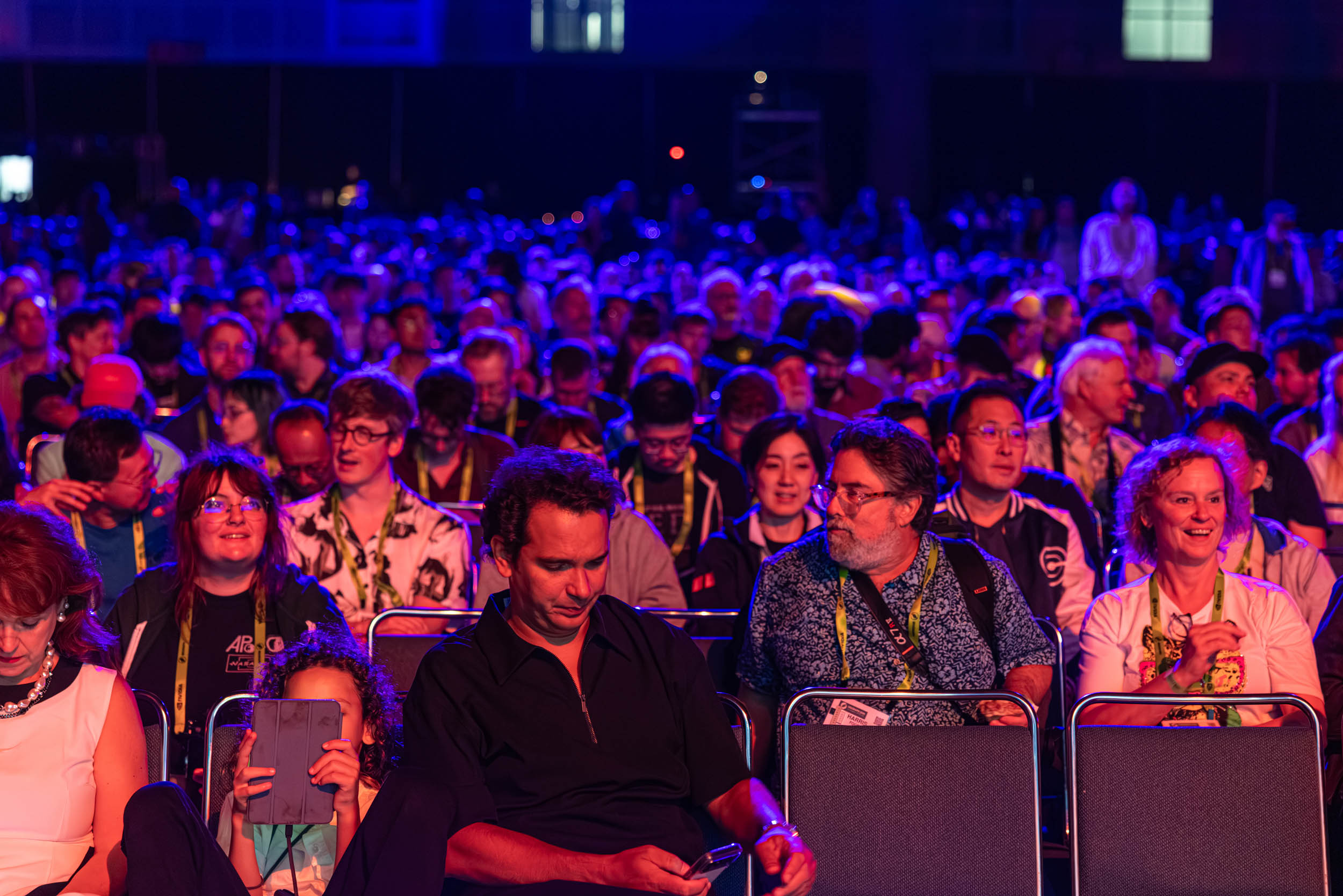
The Electronic Theatre is SIGGRAPH’s animation festival — the centerpiece screening of the year, two hours of the best animated shorts in the world, in the biggest room the conference has. Monday night it was full. The four awards were announced at the top of the night: Best in Show, Jury’s Choice, Student Film, Community Choice. Then the lights went down and we watched.
The Jury’s Choice belonged to a film about a man who finds an abandoned baby in a box — and the couple who fights to keep him. An hour into the program, it took me apart. It hit closer to my own life than the filmmakers could have known. I’ll get to that.
When the last film ended and the lights came up, the room did what rooms do: a thousand people stood, gathered their bags, and drained toward the exits at the back. I was working — photographing the crowd as it left, then slipping backstage for a few last frames. When I came back out, the theater was nearly empty. And at the front of the room, in almost exactly the spot the whole night had been pointed at, stood the couple who made that film — holding their award, talking with the Electronic Theatre chair and a few members of the crew. Their young son sat in the front row with an iPad.
A thousand people had just watched their film. The room had emptied in the other direction. Almost nobody came forward.
I walked up.
I congratulated Mikki Rose, the Electronic Theatre chair, on an outstanding show — because it was one, and because she made it. Then I turned to the couple, and I didn’t have a plan. I told them their film was extraordinary and what it had meant to me, and that I was glad they made it. We talked. I took their photograph — the two of them holding the award. I gave them my card and promised to send the picture. They invited me to coffee before the week ends.
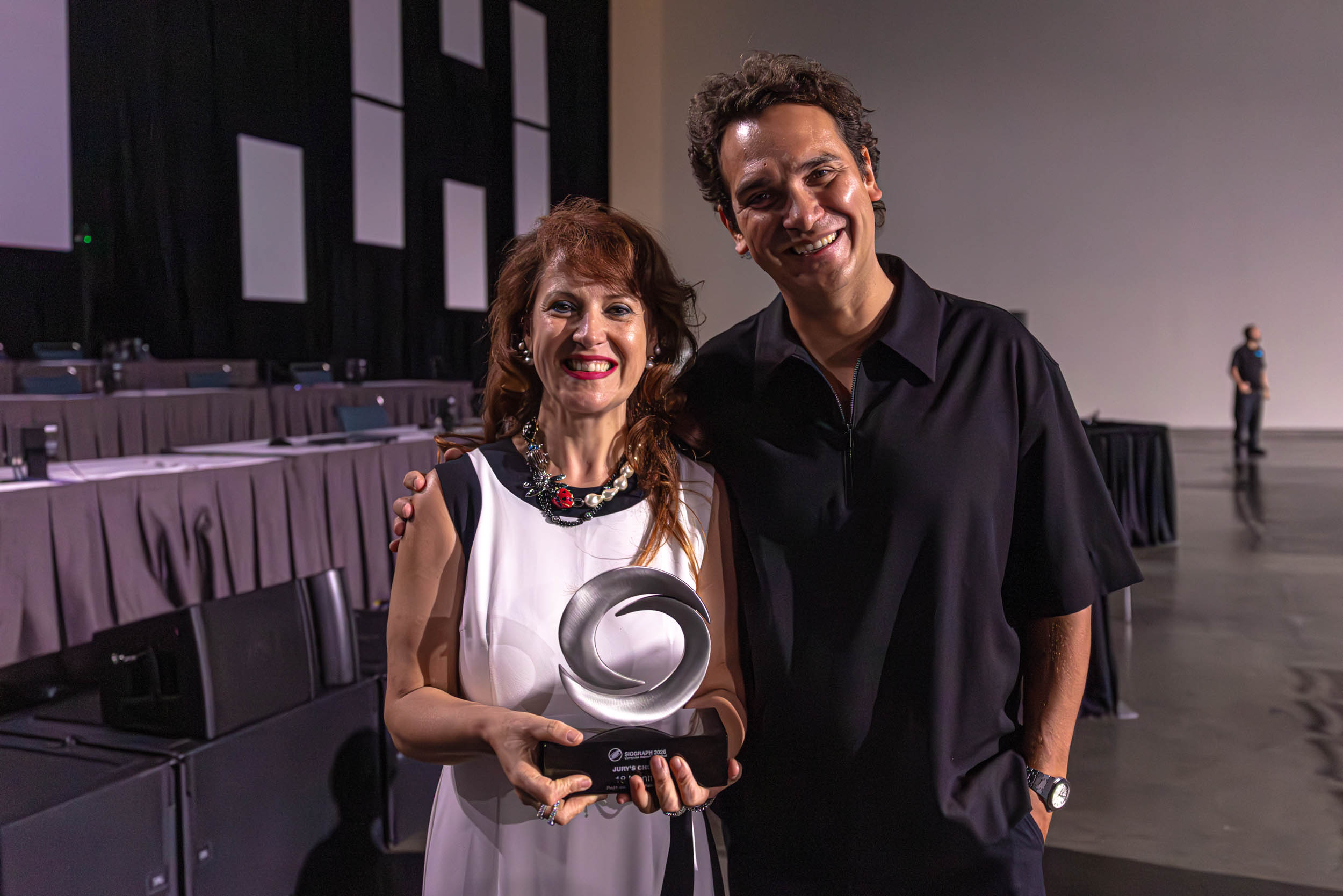
None of it would have happened if I hadn’t walked up. Most people didn’t.
This dispatch is about networking. I know — the word makes people’s skin crawl. It conjures elevator pitches and business cards thrust into palms, the person at the mixer scanning over your shoulder for someone more useful. Here is what a week at SIGGRAPH has been teaching me: none of the connections that mattered came from anything that looked like that. Not one. What worked, every time, was something that wouldn’t be called networking by anyone watching it happen.
This is the second dispatch in a four-part series written from inside this trip. The first — about how one message to an old friend became an archive role, a photographer credential, and a drive across the country — went out the night before the conference opened. Since then, more than two thousand people have read it, and something has been happening that I didn’t anticipate: people at the conference keep stopping me in the halls to tell me they read it, and what it meant to them. I wrote an essay about walking up to people. Now people are walking up to me.
Which is, it turns out, exactly how this works.
Let me show you the week.
The film

The film deserves more than the one line I gave it. A man discovers a baby abandoned in an alleyway, in a box. He brings the child home to his partner. They are a same-sex couple, and the film follows what it costs them to keep the child — the ridicule over the baby having no mother, and eventually a courtroom: a judge rendered larger than life behind a massive gavel, and a jury of whispering silhouettes, strange forms leaning into each other like the room is keeping a secret. In the end, the couple wins custody. It is based on the true story of a real couple. It was made in a blend of CG and stop motion, in an art style unlike anything else in the program.
I was adopted. I watched that courtroom decide whether a child gets to keep his family, in a room of a thousand people, and felt it somewhere most of the room could not have. So when I stood in front of the filmmakers an hour later, that is what I led with — not who I was, not what I do at the conference. What their film meant to me. It happened to be the truth, and they could tell.
They are from Brazil and live in Portugal. This is their first SIGGRAPH. When I asked how they found their way here, the husband told me he had never heard of the conference — someone mentioned it, he looked into it, and thought their film might be a fit. They submitted to a festival they didn’t know. Now they were holding a jury award from a conference accredited by the Academy of Motion Picture Arts and Sciences — the kind of place where the Best in Show winner becomes eligible for Oscar consideration. They arrived not knowing what SIGGRAPH was. They are leaving as award-winning filmmakers.
Notice what actually happened at the front of that theater, because it is this essay in miniature. The conversation opened with their work, not mine. The card came at the end, attached to a promise — the photograph I owed them. The coffee invitation came from them. Nothing about it resembled what people picture when they hear the word networking. And it worked better than anything that does.
The handshake

Tuesday morning, walking into the building, I passed a legend walking out.
An older gentleman with a long white beard — slightly like a wizard, in the best possible way. I read the badge. Jim Blinn. If you know computer graphics, you know the name; a remarkable share of what makes rendered images possible traces through his work. I was starstruck, and he noticed me looking.
I stopped and kept it simple. I called him “Mr. Blinn” — a formality I don’t normally reach for, and it felt right for someone so central to the field. I told him it was a pleasure, that we had crossed paths once at the 2008 conference, and that I hoped he enjoyed the week. He shook my hand. He looked me in the eye. I thanked him, and we went our separate ways.
Nothing in particular will come of it — and that’s fine. It was never for something. Not every introduction is an investment. Some are just gratitude: a thank-you to someone who helped build the road everyone in this building walks on. If I see him again in the halls, I’ll wave. Maybe that becomes a conversation. Maybe it doesn’t.
If networking only counts when it leads somewhere, that handshake was worthless. It was one of the best moments of my week.
The long way
Some walk-ups take thirty seconds. Some take weeks.
Chris Redmann is the conference chair of SIGGRAPH 2026 — the person at the top of the volunteer structure that makes this entire event happen. I met him this week, and he told me he’d love to sit down for a chat. I intend to take him up on it.
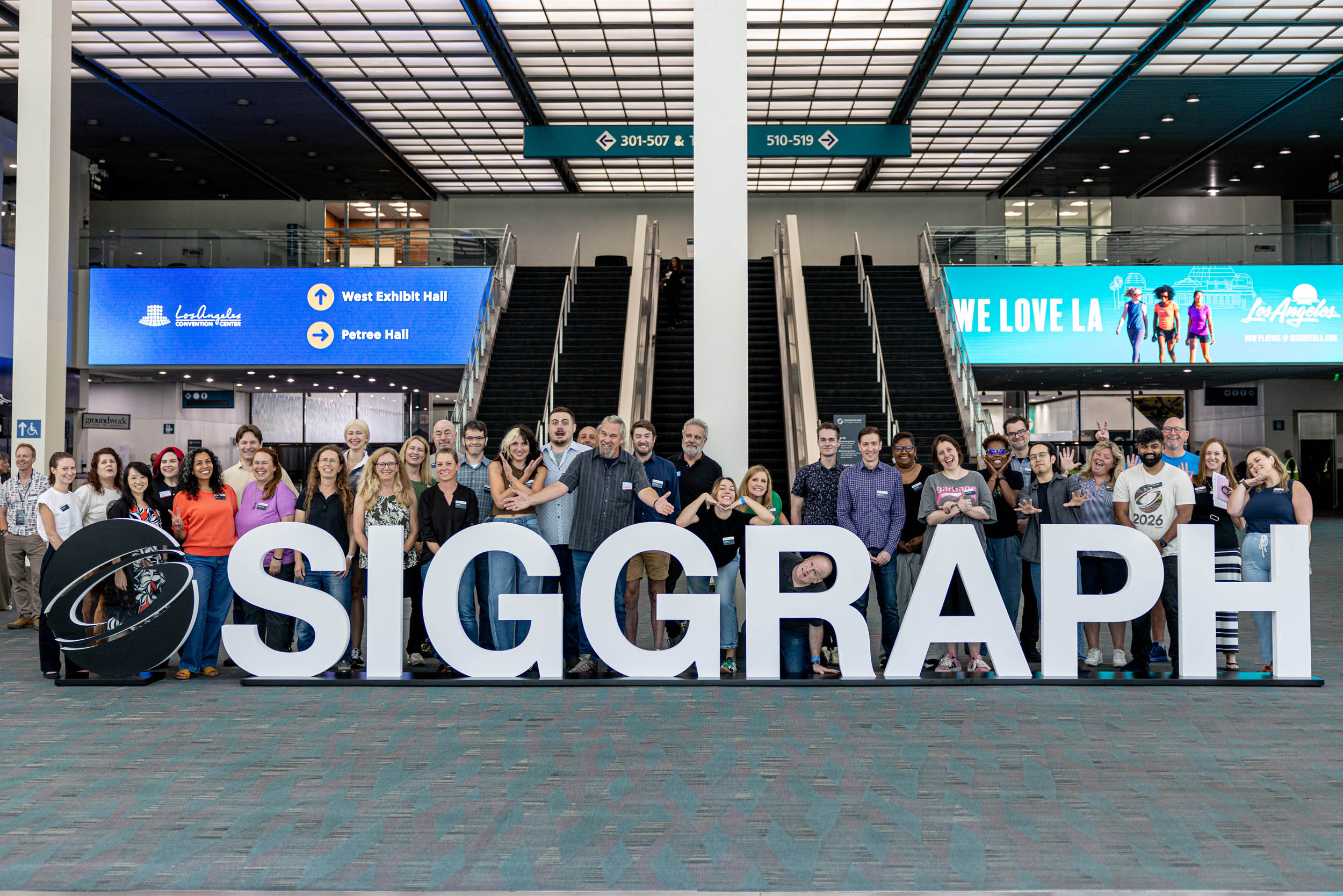
From the outside, that could look like access. It wasn’t. It was the end of a long, slow introduction. I connected with Chris on LinkedIn weeks before the conference. On Saturday, he stood in the group photo I was honored to take of the conference chairs and committees. He has seen me all week — camera up, working, everywhere. By the time I introduced myself, most of the introduction had already happened. Chris wasn’t responding to what I said. He was responding to what he’d seen.
There’s an old line about digging your well before you’re thirsty. This is what it looks like in practice. Not a pitch delivered at the right moment — a body of evidence, accumulated before any moment arrives. And the evidence has to be real. I am not holding a camera this week as a networking tactic. I’m holding it because this work matters to me and I wanted to do it well. That’s what makes it work. People can tell the difference between someone building a reputation and someone performing one.
The well
The oldest relationships in this story never started as asks either.
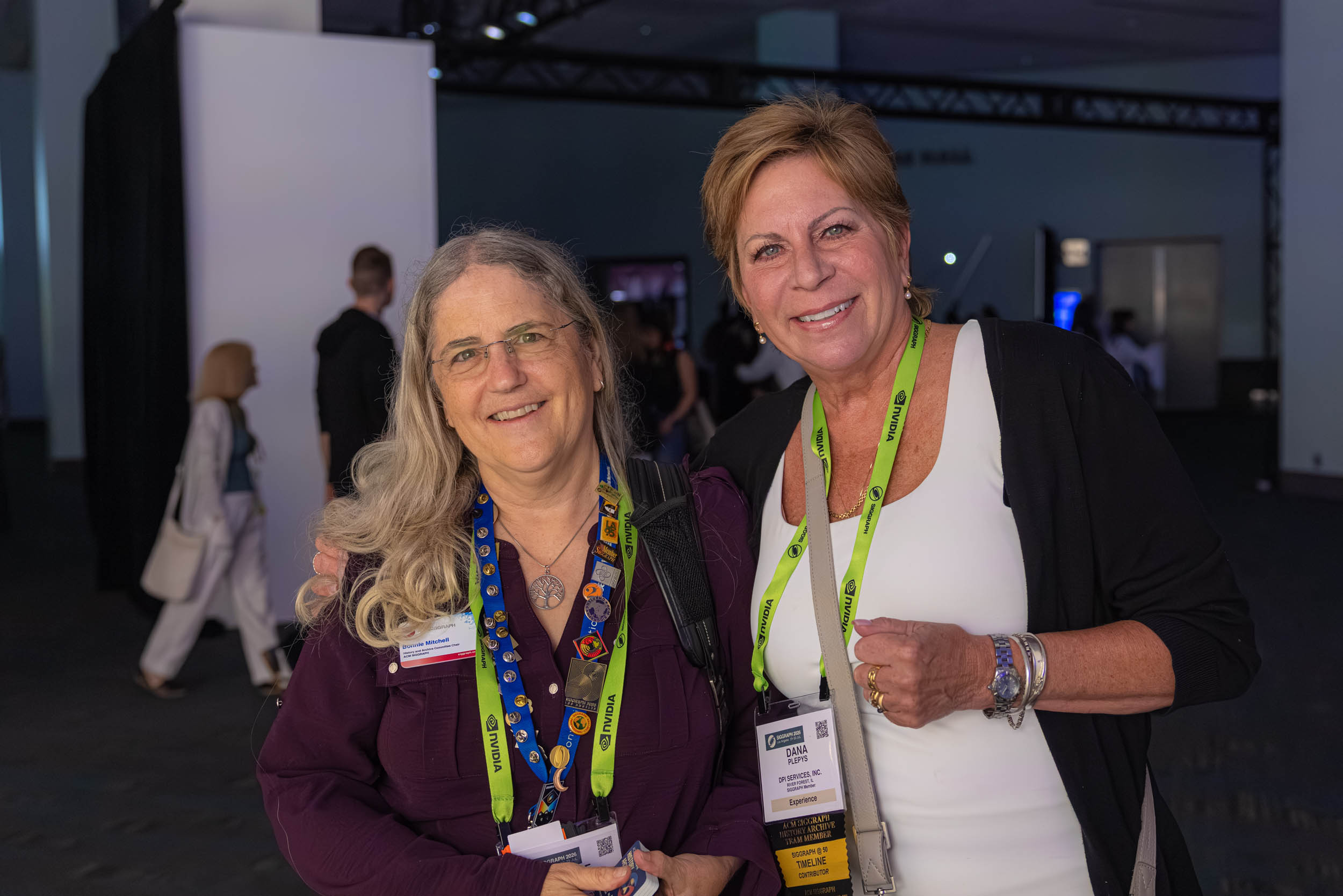
Dana Plepys and I found each other in the art gallery this week. We hadn’t seen each other in about ten years, and it was such a treat — she is a dear friend and has done so much for me, including vouching for me with the History and Archive team. It was Dana I messaged back in the spring, a catching-up note with an honest question inside it. That note is the reason any of this exists.
Bonnie, who leads the archive team, made it official this week in the way institutions do: a flag for my badge, and a stack of printed business cards. ACM SIGGRAPH History Archive. My name on the back. I keep looking at them.
Bonnie, I’ve learned, is retired — and spends more than sixty hours a week on the archive. Read that again. Sixty hours, retired, keeping a field’s memory alive. That is not a budget line or a job description. That is a person who decided the past matters and shows up for it every single week.
Ernest is here too — my friend and former Nickelodeon boss, now at DreamWorks. We’ve been trading messages on WhatsApp all week and meeting up wherever the schedule allows. Twenty years of friendship, still compounding.
And then there are these dispatches. I wrote the first one as an essay, not an outreach strategy. But two thousand readers later, with people stopping me in the halls to talk about it, I’ve realized the writing belongs in this story too. Sharing what you’ve learned, publicly, is digging the well while giving back — you offer something real, and some of the people it reaches decide to walk up to you.
Why most people don’t
So why did a thousand people file past two award winners on Monday night?
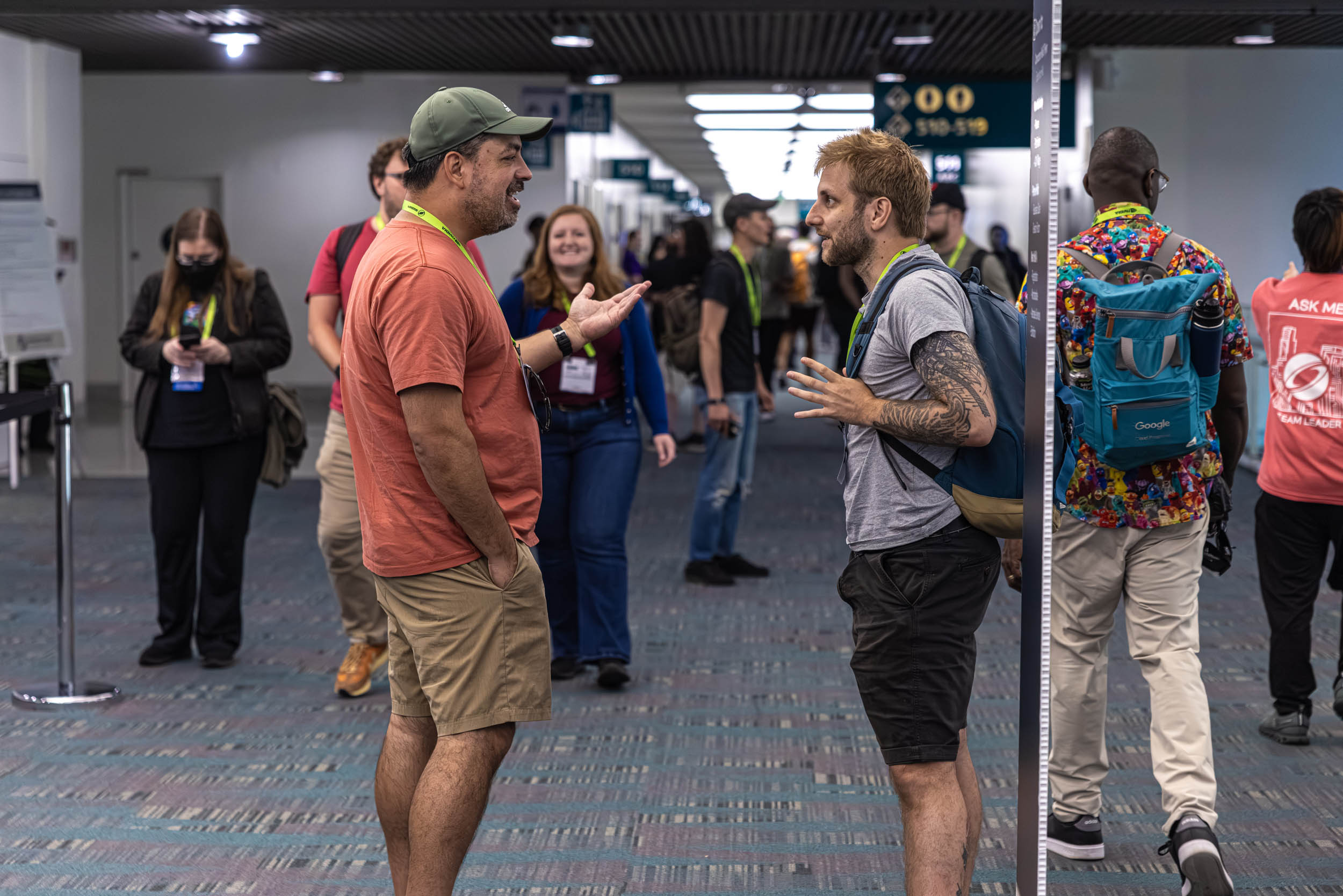
Not rudeness. Not even shyness, exactly. I think most people believe walking up requires something they don’t have — a reason, a pitch, a status, an opening line worthy of the moment. They’re waiting until they have something to say. But the couple at the front of that room didn’t need anyone’s pitch. A single true sentence — your film meant something to me — was worth more than every elevator speech in the building.
The other thing that stops people is the opposite problem: they see the status instead of the person. A fan leads with someone’s fame — and fame is a wall, because the famous person has heard every version of it. When you idolize someone, you’re actually talking about yourself: your awe, your nerves, your need for the moment to go well. The alternative is to find the person inside the role. Listen to their story. Find what’s actually shared between you — not “what inspires you,” not “how did you get your start,” but the real thing, the specific thing. Lead with that.
And never lead with the ask. The moment you open with what you want — a job, an introduction, a favor — you’ve changed the context of the entire conversation. It stops being an introduction and becomes a transaction, and people feel the shift instantly. The line between networking and desperation is exactly there.
Here is the permission slip most people never realize they’re holding: a conference is the one room where walking up is the entire point. Chris Redmann comes to be met. So does Jim Blinn. So does everyone with a badge, from the students checking yours at the door to the legends George Lucas used to wander these halls among. Nobody here thinks a stranger saying something true is an interruption. It’s what the building is for.
The cost
I want to be honest about what this week takes, because leaving it out would make all of this sound easier than it is.
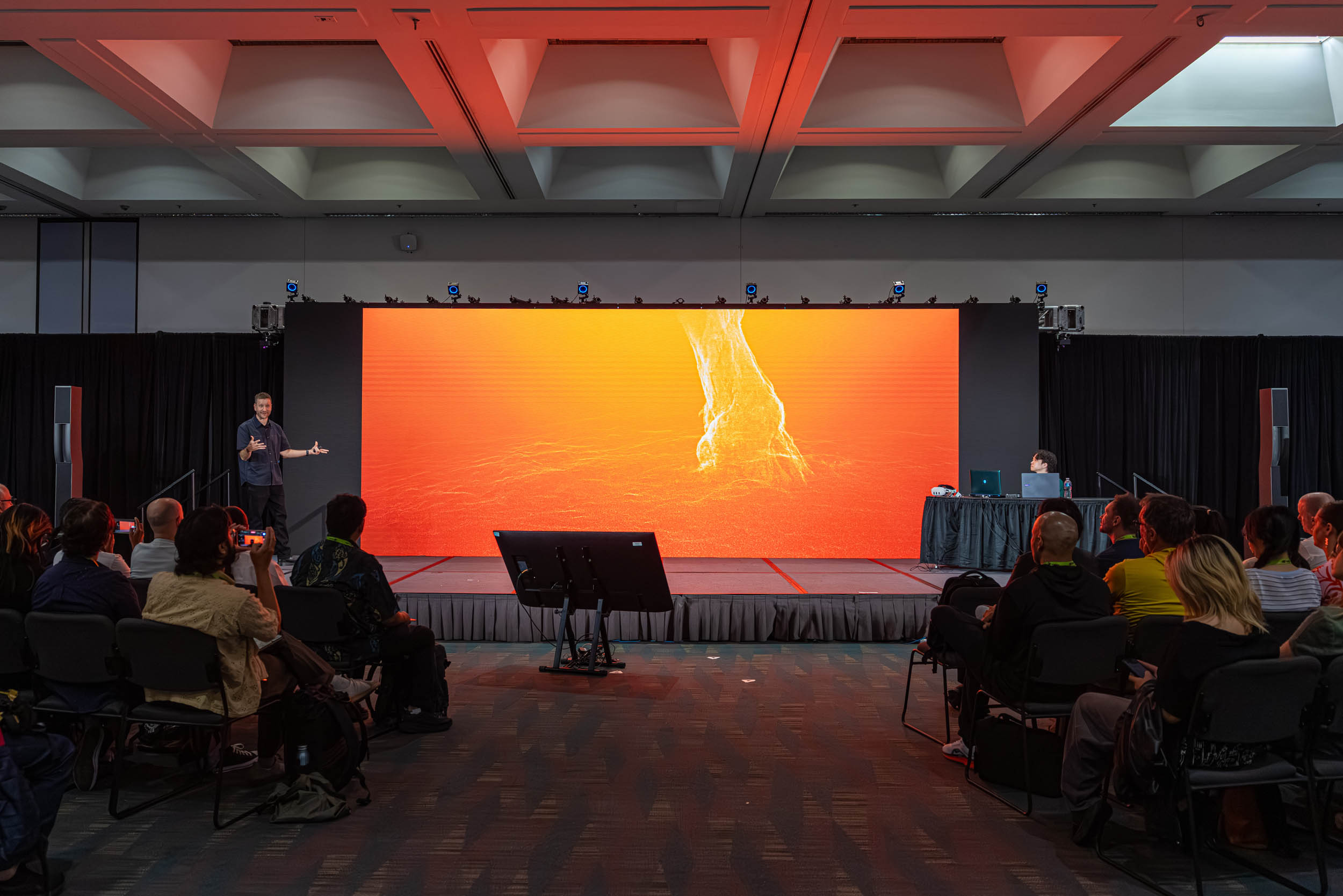
Monday ran seventeen hours by the time the evening’s photos were processed. I went to bed at two and got up at six. I’ve been at the convention center since Saturday, and I am running on fumes — and not only because of the schedule. My body makes weeks like this cost more than they look like they should. I would not trade this week for anything. Both of those things are true at once.
Every walk-up in this dispatch happened tired. That’s worth saying, because showing up isn’t a mood that arrives when you’re rested and confident. Some days it’s just a decision.
The other side of the table
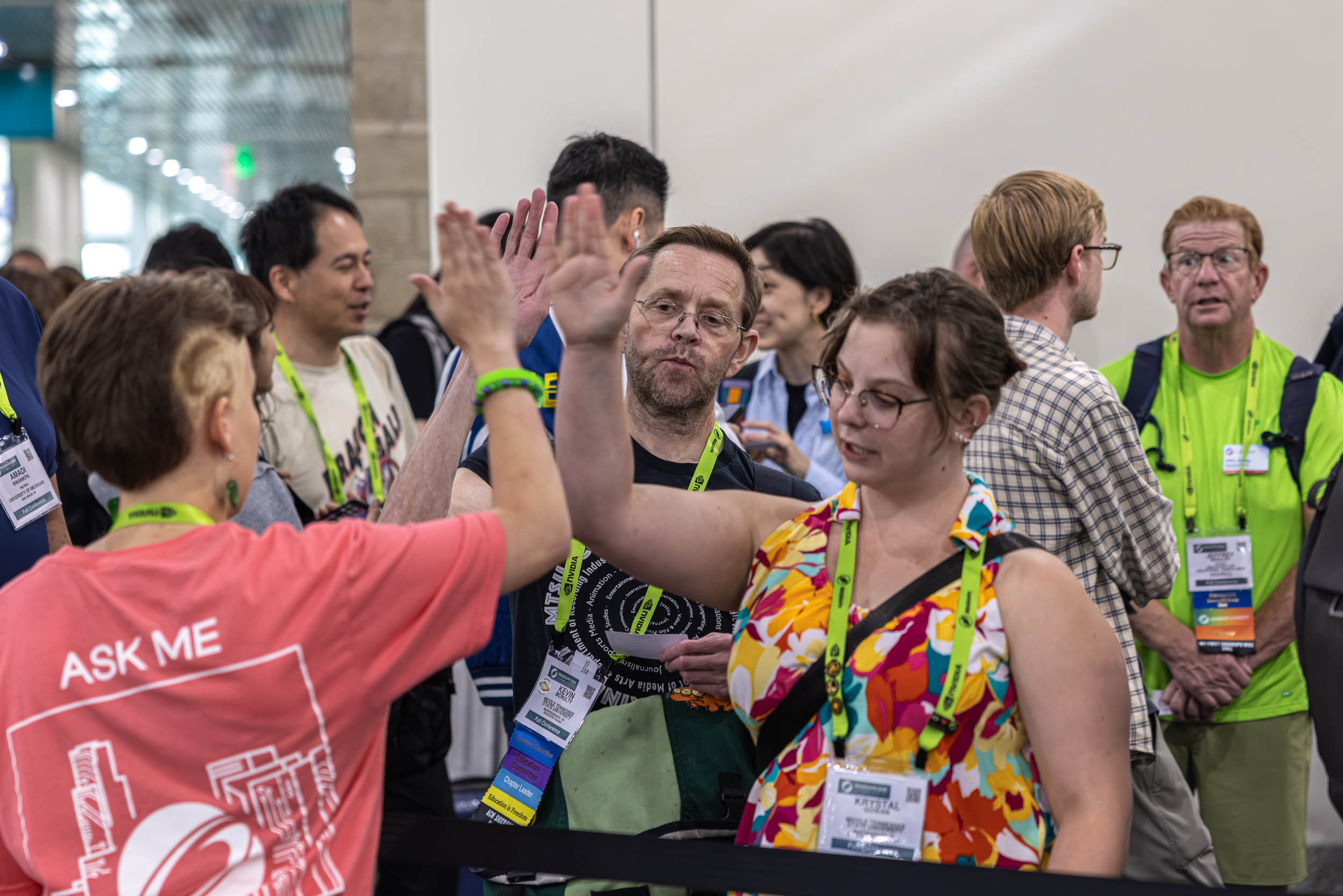
The student volunteers are the backbone of this conference. Some of the brightest students in the world apply for the program — they check badges, direct traffic, answer questions, and hold the whole event together, the way they have for decades. I was one of them here, nineteen years ago.
This week, one of them walked up to me.
He was curious about archiving and CG pipeline work — genuinely curious, the real kind. I told him about the Discovery project I developed in Australia: the data structures, the way the system held a community’s cultural material. I showed him screenshots. He was in awe — and I made sure to tell him the part that matters: nothing about that work is out of his reach. There is no credential wall between him and building things like it. He has my card. He says he’ll be in touch, and I believe him.
Notice: his approach worked on me exactly the way mine worked on the filmmakers. No pitch. No angle. Just real interest, plainly expressed. The method is symmetrical — it works at every level, in both directions, on students and legends and everyone in between.
And somewhere in that conversation I understood that my role here has quietly flipped. Nineteen years ago, people at this conference welcomed me, encouraged me, told me I belonged in rooms that felt too big. Now I’m the one saying it — to a student volunteer with his whole career ahead of him, to two filmmakers holding their first award at a conference they’d never heard of a year ago. The welcome I got is mine to give now.
Two more days
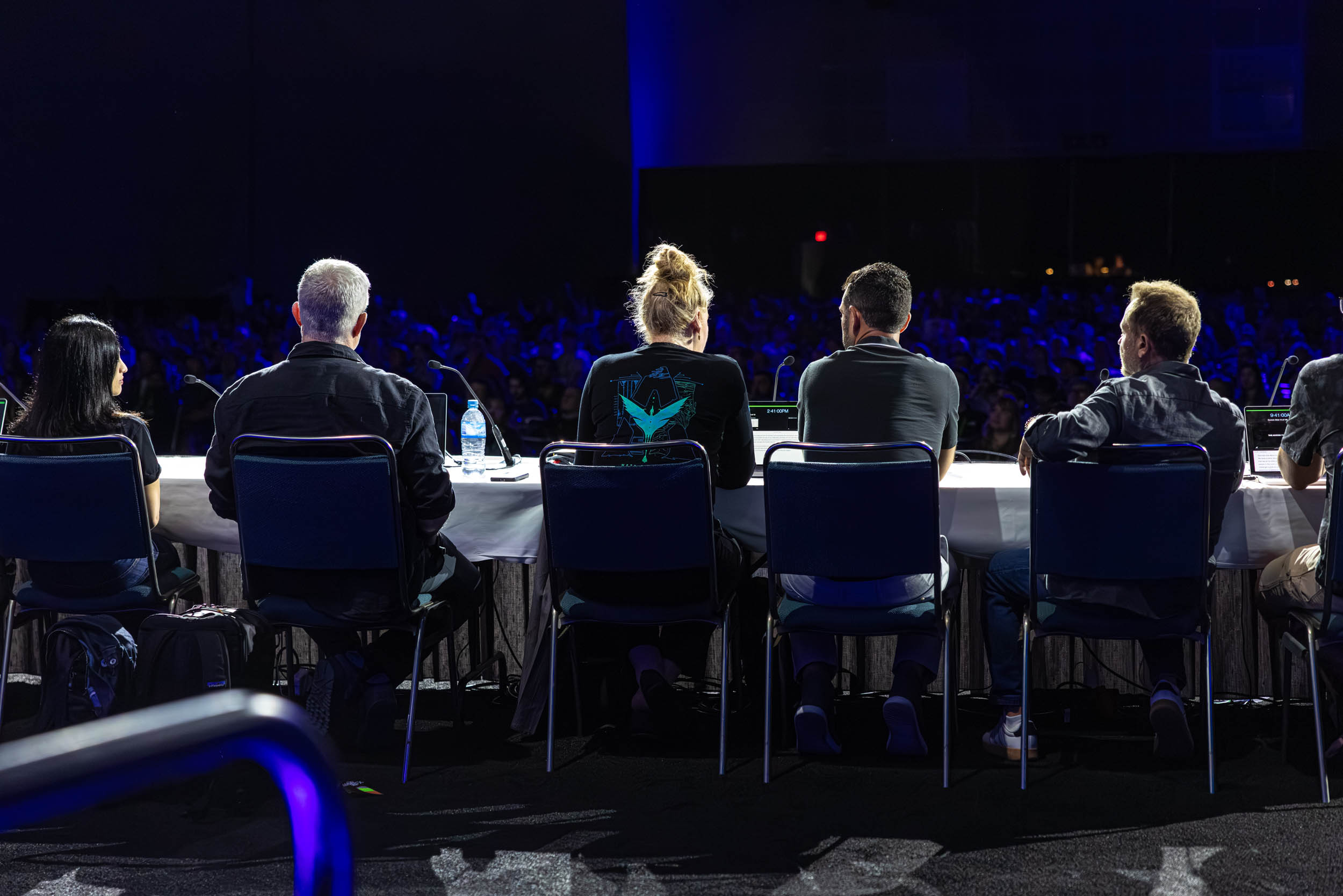
The conference ends Thursday. The room that filled on Sunday will empty for good, and everyone in it will scatter back across the world.
What a week like this leaves behind isn’t the sessions. It’s the sentences said to strangers — the thank-you at the doorway, the compliment at the front of an emptied theater, the true thing offered with no ask attached. Some of those sentences go nowhere, and were still worth saying. Some of them turn into coffee, or a sit-down with a conference chair, or a student’s email that arrives months from now. You don’t get to know which is which in advance. You only get to decide whether to walk up.
Most people didn’t.
Tonight, before I sleep, I owe two filmmakers a photograph. That’s the other half of walking up that nobody talks about — the small promise you made in the moment, kept afterward, when you’re exhausted and it would be easy to let it slide. The picture goes out tonight.
Two more days. The room is still full.