
I Have Seen This Film: An Animator's Letter on Platform AI
The wolves
The film opens on an art deco office, the kind of room you would find on a 1930s movie poster: desks in neat rows, clean, the whole interior rendered in simple line illustration like a draftsman’s sketch. Nine wolves sit at the drafting tables in vivid full color, hand-copying documents with pencils.
A door on the back wall opens. A bulldog walks in. He is the boss — same era of dress as the wolves, but he comes through a door they do not come through. On the wall next to him is a large red button.
The first wolf collapses from overwork at his desk. The bulldog pushes the button. A trapdoor opens beneath the wolf and he falls through it. A robot rolls into the room — three-dimensional, cel-shaded, work that still holds up against anything CG does today — slides into the wolf’s chair, and starts writing. Faster.
This is the first thirty seconds of a five-minute animated short from 1988 called Technological Threat, directed by Bill Kroyer and Brian Jennings.[1] The wolves are drawn by hand. The robots are computer-generated. Kroyer and Jennings described the film, on its release, as an experiment in whether traditional and computer animation could share a frame. They described it, in the same breath, as an allegory for whether the people inside those two techniques could share an industry. By its end, it is something stranger than either.
Over the next minute and a half, the other eight wolves are dispatched one at a time — each one for the crime of having a body. A yawn. A sip of water from a glass on the desk. A sneeze — and the sneezing wolf tries to suppress it by plugging his nose with two pencils, sneezes anyway, propels the pencils into a coworker’s forehead. They both fall through the floor. Each wolf, as he goes, is replaced by a robot that does the work faster and doesn’t sneeze.
Then the film cuts back to the bulldog. He is, suddenly, a robot. There was no trapdoor for the bulldog. There was no transition. There was no on-camera replacement. The boss-robot just is. He stands at the back of the room for a beat, then walks out through the boss’s door, the same way the bulldog always did.
The last surviving wolf is scribbling so frantically at his desk that smoke is rising from his paper. He does not notice. When the boss-robot finally walks out, the wolf raises his head. He stops scribbling. He reaches into a drawer and pulls out a stick of dynamite.
What follows is close to two more minutes of Chuck Jones–grade chaos. Anvils. Dynamite. One robot electrocuted into a pile of cinders. The lone wolf and the last surviving worker robot end up trading punches on the office floor. Mid-fight, they look up. The boss-robot has returned. He is reaching for the red button. The wolf and the worker robot look at each other, and in a moment of cooperation neither character has earned, they cartoonishly slide the trapdoor itself out from underneath their fight, scoot it across the floor, and let it settle under the boss-robot’s feet. The boss-robot, oblivious, pushes the red button. The trapdoor opens. He falls through it.
The wolf claps the worker robot on the back. Then he looks at the open trapdoor. Then back at the robot. Then back at the trapdoor. You can see him doing the math. Then he shoves the worker robot through too.
The film ends with the wolf alone in the office. He lights a cigar. He walks to the red button. He smiles at the camera and pushes the button at us.
Kroyer and Jennings made a more complicated short than its premise suggests. The technology, in their telling, isn’t the villain — the surviving worker robot ends up on the wolf’s side, at least long enough to take down the boss. The boss isn’t quite the villain either; the boss in the film is replaceable, and the wolf who survives ends with the boss’s cigar in his hand and his finger on the red button. What the film is actually arguing is harder than the discourse around this technology has lately been able to host: surviving a wave is not the same thing as escaping the cycle. The wolf who wins is the wolf who has learned to push the button himself.
The film was nominated for an Academy Award for Best Animated Short. It lost to Pixar’s Tin Toy — the first animated short ever made entirely by computer. Something that had never been done before.
I have been thinking about Technological Threat constantly the last few weeks, because I think the field I am writing into is about to make the trapdoor again.
What they did
I wrote the first piece in this series, Losing Each Other, the week after Jorge Gutierrez withdrew from a project at Amazon. A friend mentioned to me recently, in passing, that I “seemed surprised by the reaction to Jorge” in that piece. I have been thinking about that comment, because some version of it is what I want to address here.
The argument of the first piece was not that Jorge was beyond critique. It was not that he should not have anticipated the backlash. It was a structural argument about a tactic. The tactic of pile-on hostility toward any maker who touches AI tools is not changing what the corporations build. It is only changing which makers are in the room when the corporations build it. That distinction is the spine of both essays in this series, and it is the distinction I most want to be clear about before going further.
This essay picks up that argument and asks what the corporations have been doing while we have been losing each other in public.
The short answer is that they have not been waiting.
The lawsuits stack deep enough that there is a tracker for them, which is the kind of detail that tells you how unusual the moment in the law is. Bartz v. Anthropic settled in November for a billion and a half dollars — the largest copyright settlement in U.S. history.[2] Disney is suing Midjourney and MiniMax. UMG, Sony, and Warner settled with the AI music generators Suno and Udio. The New York Times is suing OpenAI. The legal layer is going to take years to sort itself out, and even after it is sorted, the architecture of the wave will already be in place.
While the lawsuits churn, the corporations have also been signing deals. In December, Disney announced a billion-dollar investment in OpenAI to integrate Disney characters into Sora.[3] The deal collapsed in March, but only because Sora was failing in the market. Not because Disney decided AI was unethical.
Read the lawsuits and the deals together and the studios’ position comes into focus. The studios will sue an AI company when their character IP is at risk. They will negotiate with an AI company when it benefits them. They will not sue when their workers’ art is in the training data, because that is not their fight. There are two fights here, and they are not the same one. The studios’ character-IP fight is in the news every week. The workers’ art-in-training-data fight is not in the news, because the studios are not fighting it for them. The artist coalition is mostly fighting it alone.
That is the situation as I read it. It is also where the longer answer to the question I asked at the top of this section begins.
The Spotify confession
There is a company called Bria. Most of the people I have spoken to who think there is an “ethical AI” path forward have said the name. Bria is, on the dimensions Bria claims, the best of the companies trying to build something other than the scraped-from-the-internet model. Their AI is trained exclusively on licensed data from more than thirty content partners — Getty Images, Alamy, Envato, Depositphotos, and others.[4] Bria was among the first companies to receive Fairly Trained certification when that program launched in 2024. They won the top two awards at this year’s Hollywood Professional Association Tech Retreat. They have announced an initiative with major Hollywood studios to build a jointly-owned AI model trained on participating studios’ libraries. Their customer list includes Microsoft, WPP, Publicis Groupe, Epic Games, WildBrain, and Toon Boom. None of this is theater. The company has done real work.
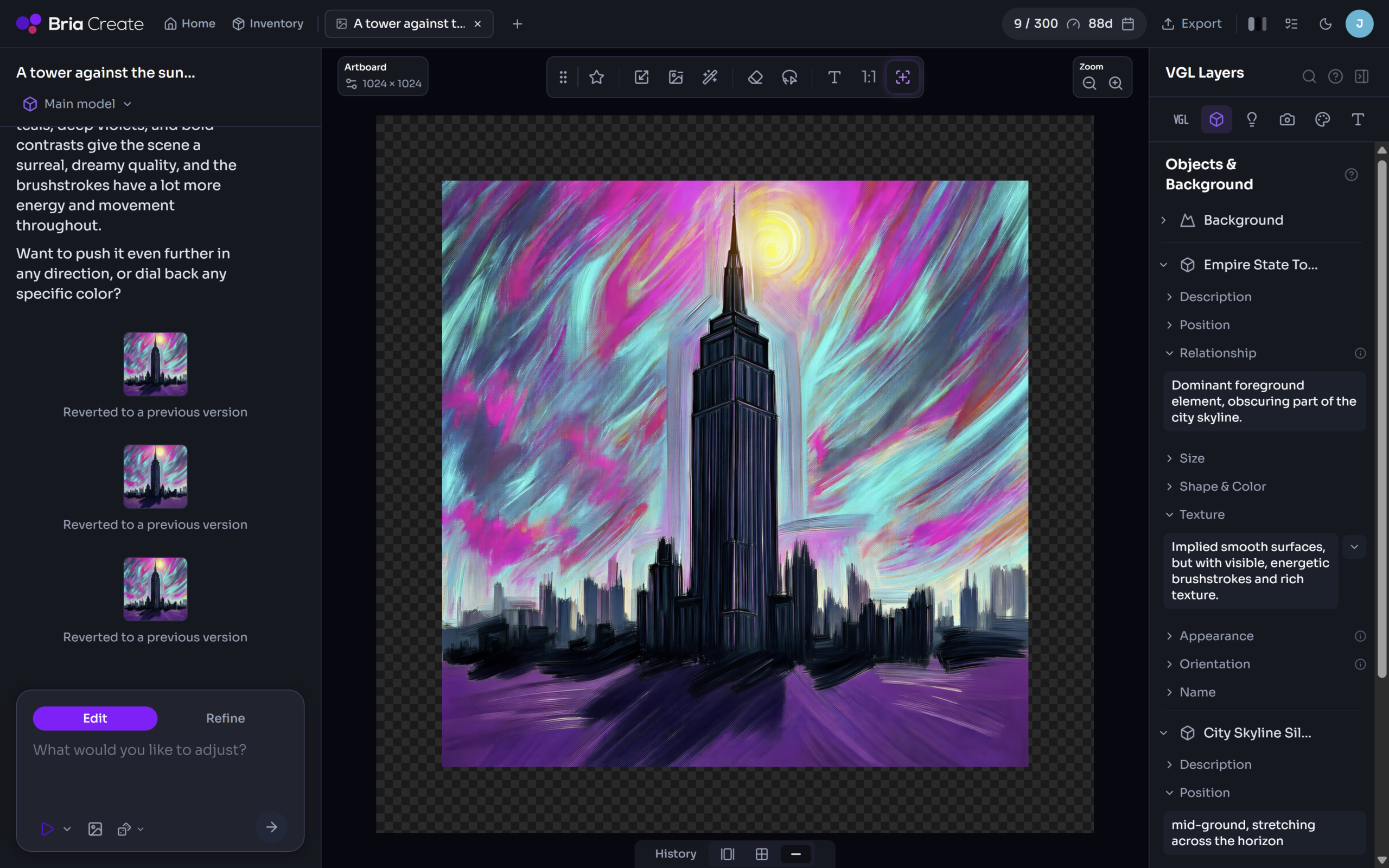
I signed up to Bria a few days ago because I wanted to see for myself. Before I tell you what I think is wrong, I want to tell you what is right. The platform is built for people who actually do the job. The artist controls are the heaviest I have seen in anything outside a traditional creative pipeline — you dial in lighting, camera, composition, character posture, the explicit visual parameters that any creative program lets you adjust. The work is iterative. You could spend an evening on a single image and feel like it was an evening well spent. Whatever I am about to say about the company, I want to be clear that what they have built is not Sora. It is not Midjourney. It is a tool you could craft with.
I want all of that on the page before I get to the disagreement. The disagreement is not about the quality of the tool. It is about the architecture under it.
On Bria’s own licensed-training-catalog page, in the section that explains how the compensation system works, this paragraph appears:
Piracy nearly broke the music industry. Spotify did not win by ethics alone. It won by building a better product through a sustainable model. Artists earn from real usage. Users get unlimited access. The product improves continuously. Bria applies the same model to generative AI.[5]
That is Bria’s own description of the model they are proud of.
The Spotify analogy is not flattering.
Spotify pays artists between three and five tenths of a penny per stream. When TechCrunch asked the Union of Musicians and Allied Workers what Spotify pays the working artist directly, the spokesperson replied:
It’s easy to calculate what Spotify pays directly to recording artists: zero dollars.[6]
The Spotify system pools revenue across the whole platform and pays out pro-rata, which means smaller artists with loyal listeners get crushed in the pool. Working musicians have been organizing against this model for a decade. Their field does not remember it fondly.
This is the model Bria says it is applying to generative AI.
The architecture follows. Bria licenses the training data from the agencies — Getty, Alamy, Envato — not from the artists whose work fills the agencies’ catalogs. The agencies in turn pay their contributors a small share of whatever they get. Getty Images compensates its contributors when their work is used in AI training, but the share is small enough that when Adobe ran a similar setup at Firefly, one Adobe Stock contributor took it to arbitration and lost.[7] Bria’s revenue split between the platform and the creator is not published anywhere I can find. The attribution engine — the technology the whole “ethical” claim rests on — is described on the company’s own page as patented and as creating an irreversible vector that cannot be reversed to reconstruct source images.[8] Outside researchers cannot audit the math. We have to take Bria’s word that the attribution correctly weighs which training images influenced which output.
The Hollywood studios initiative is where the issue gets cleanest. The studios contribute their content libraries to the jointly-owned model. Read the wording carefully: the “creators contributing” are the studios that own the IP — not the storyboard artists, not the illustrators, not the animators whose pencils moved on those frames, working as employees or under work-for-hire decades ago. The studios hold the rights. The compensation flows up to the studios. It does not flow down to the makers.
This is what my friend Sam Tung, who is Co-Chair of the Animation Guild’s AI Task Force, has been naming in print. Here is the line of his I cannot find an argument against:
None of the people who put their years of work and skill that’s in the dataset are going to be compensated. Their work would literally be used to train a system that replaces them, even if it’s considered to be ethical.[9]
Even if it is considered to be ethical.
This is where I have to say what this letter is for. The artist coalition I support — the OSTP letter signatories, the Stealing Isn’t Innovation campaign, the Make It Fair campaign — is right about the harm. The work was taken. The people who made it are not being paid. The damage to the field is real. But the answer the coalition has currently coalesced around is wrong. The platform-aggregator companies the coalition is pointing to as the path forward are doing what Spotify did. The architecture of the previous wave is about to be repeated with a coat of consent painted on it. The corporations are going to walk away with a moral premium they did not pay for. And most of the wolves are going to go through the trapdoor.
The wolves in 1988 understood the difference between the boss and the technology. The discourse in 2026 is asking us to forget it.
I have seen this film.
The archive
I want to step back from Bria and tell you why I am sure about this read. I have not pulled it from theory. I watched the previous wave on video tape, one short film at a time, in 2008. The way I did this is the strangest job I have ever had.
That summer I was twenty-two and living in my first terrible apartment in North Hollywood. The carpet was worn. The blinds hung crooked. The couch was old but comfortable and smelled the way old couches smell. One afternoon a police raid happened across the street and the armed suspect ended up on the sidewalk in front of my bedroom window. The visuals of SIGGRAPH were much more interesting than my apartment.
The reason SIGGRAPH was on the floor of my apartment was that the conference — the place the computer-graphics field has been chronicling itself since 1974 — had handed me the job of curating thirty years of its film catalog for its 35th anniversary retrospective.[10] The archive lived on one hundred and fifty-eight tapes, SIGGRAPH Video Reviews, the institution’s own running record. The earliest of them went back to 1979. The format was already obsolete by 2008. I had to go out and buy a VCR.
The job ran most of a year, alongside my days at Nick Digital — the small effects-and-pipeline department in the former gift shop of Nickelodeon Animation Studio, where I had just started. The room had no windows. The ceiling fixtures above our desks were enormous cartoon-face cutouts hanging from wires, with lightbulbs where the eyes should be. One of the things I did at Nickelodeon was hire interns. It was 2011 and I was hiring for my department. I found the perfect candidate. His name was Sam Tung — the same Sam I quoted two sections ago. I had a feeling, the day he turned up for the interview that summer, that he was going to do well in the field. I did not have the imagination, that summer, to picture this essay.
What I saw working through the archive over those months was the entire shape of how a medium gets born and how the people who build it get sorted. The first wave of computer graphics arrived in the late seventies and through the eighties through dozens of small studios. Cranston/Csuri Productions. Pacific Data Images. MAGI Synthavision. Sogitec. Omnibus Computer Graphics. Digital Effects. Digital Productions. Japan Computer Graphics Lab. Robert Abel and Associates. Symbolics Graphics. Bo Gehring. Whitney/Demos Productions. Toyo Links. There were many more. Most of them were gone by the mid-nineties. A few — Pixar foremost — survived, and they became the names the field is known by today.
The work the others made survived too, partially, on those tapes. The ones that survived, that is. When I got the working inventory of the SIGGRAPH Video Review collection, twenty-five of the tapes were marked, in plain capital letters, MISSING.[11] Whole stretches of the late eighties and early nineties were gone — from the conference’s own catalog, twenty years after the work had been shown. About a sixth of the institution’s own record could not be located by the institution. The studios that had made the work were also gone. There was nobody left to call.
The platforms are not archivists. That is the sentence I came out of those months with, and I have been waiting eighteen years for someone to tell me it doesn’t apply this time.
Technological Threat was on one of those tapes — SVR038, from 1988. I watched it on a Sunday in May, on the floor of the apartment, after a day at the studio. Very applicable to today’s animation….Nick Digital? That was the note I scribbled afterward. I was watching a thirty-year-old film about workers being replaced by robots, having just spent the day at the small studio where, in a way I had not yet found language for, that same conversation was happening around me. The film had already done what I am trying to do now. The eighteen years between then and now have not changed the conversation. They have only made it faster.
Sam
About Sam.
I introduced him a couple of sections ago — the friend I hired into Nick Digital in 2011. In the years between then and now, Sam moved up. He became a storyboard artist. He worked on shows. He sat on the Animation Guild’s 2024 contract negotiations committee. He is now Co-Chair of the Guild’s AI Task Force, which I learned almost by accident in the last few weeks.[12] I will be honest about how the realization has felt: a little bit like the field had been rearranging itself around me without telling me. The colleague I once brought into the studio is now sitting in the room where the field’s actual positions on AI are being negotiated. I am writing letters from outside that room. The field has a sense of humor about how it puts people in the places they end up.
Sam and I agree on most of what I have written above. He has been on the public record in ways I deeply respect. The line of his I quoted in the Bria section — even if it’s considered to be ethical — is the one I have not been able to find an argument against. The harm is real. The artist coalition is right about the harm.
Where Sam and I disagree is on the Animation Guild’s official position on AI itself. The Guild’s website states:
GenAI will never be able to do what we do, and by organizing, we can ensure a future where our art, stories, and work remain beautiful, meaningful, and human.[13]
I think never is the wrong frame, and rejecting a Guild position is not something I want to do casually, so I want to be clear about why.
The statement is that GenAI will never be able to do what we do. The premise underneath that line, once you sit with it, is that AI output will always lack human artistry. That premise is already false. There are animators today working with AI as part of their craft — bringing intent, taste, framing decisions, refusals to the work the way animators have always brought them to the work. What comes out of that practice has artistry in it because there is an artist behind it. We cannot create without a maker. As more animators come up using AI tools alongside the traditional ones, the category of “AI work” will increasingly contain real animation made by real animators. The capability gap is also closing on the other side — not all the way (the tools alone cannot do what an animator does), but every year a little more. A “never” claim built on capability has been losing ground for a decade and will keep losing it.
The stronger position, I think, is to refuse the capability frame entirely. What we do is not the artifact. The artifact can come from anywhere. What we do is artistry — the care that decided which mark to make, the intent that shaped the framing, the taste that chose the cut, the refusal that decided what would not be in the frame. Artistry is a property of the human at the tool. The tool alone cannot perform it; an animator with the tool can.
To hold the “never” position is, in effect, to define an animator who works with AI as not an animator. And that definition serves the AI companies more than it serves the field. It lets the corporations call AI output something other than “real” animation, separated from the prestige of the artists whose work was in the training data, without ever having to defend the separation. The Guild’s line, however well intended, hands the corporations the frame they need.
The harder position — and the right one, I think — is that artistry is what defines the work, and that artistry can travel through any tool, including this one. The fight is not over whether AI will do what we do. The fight is over who counts as the artist when AI tools are part of the work.
That disagreement is friendly. It is the kind of disagreement two people from the same field, who hold different positions on a hard question, ought to be able to have without it ending the friendship. The discourse around AI has somehow lost the ability to host this kind of disagreement. It has been treating any difference of opinion as betrayal. It is not. It is how a field is supposed to work. If we cannot do it, we will not be able to do any of the harder things waiting on the other side of it.
After this wave
What I want, after this wave is decided, is to keep being in a room with the people I disagree with. With the Sams. With the people who think Sam is too gentle. With the people who think I am too generous to the platforms. With the artists who want to fight against, and the artists who want to fight from inside. With the people building the platforms, and the people building the alternatives. I want a room large enough for the people still figuring out what they think — which is most of us, including me — and a room where you do not get driven out for being curious, or for refusing, or for using a tool and saying out loud that the tool has a problem.
There are alternatives, in shape, already. EleutherAI’s Common Pile, released last summer, is eight terabytes of public-domain training data, and the two models they trained on it perform competitively with Meta’s first Llama.[14] Public-domain AI is not a fantasy at the seven-billion-parameter scale. Artist-built tooling exists, too — Nightshade and Glaze, Spawning’s Have I Been Trained, Fairly Trained’s certification.[15] None of these are consolation prizes. They are what gets built when the makers are at the table. The Animation Guild, with the labor infrastructure it already has, is the institution that could license its members’ collective contribution to a training set on terms the Guild controls. That counterparty exists in shape. It does not yet exist in operation. This essay is, in part, an argument that it should.
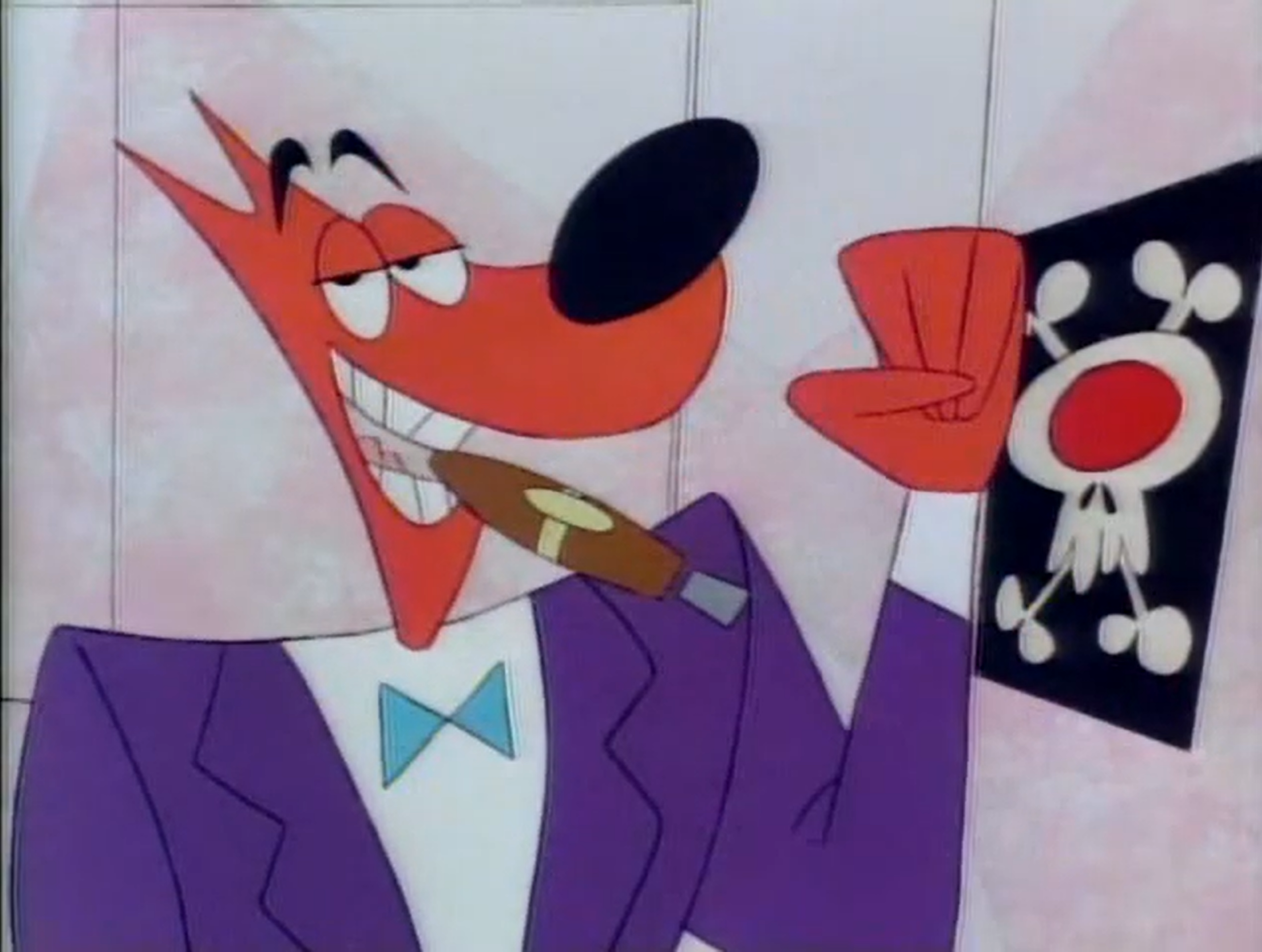
Most of the wolves go home in 1988. One does not — but he doesn’t escape, either. He ends the film holding the boss’s cigar, finger on the boss’s red button. The film refuses to let him win cleanly. The question it leaves the viewer with is the question I think this letter has to leave its reader with: what kind of survivor do we want to be? The previous wave did not end with the wolf at the button. The studios that survived the CG transition still paid their workers; they ran on the studio model the medium had always run on. The wave being designed right now is being designed differently — around platform aggregators that pay agencies and corporate rights-holders instead of the workers themselves. There are trapdoors being installed. There are buttons being wired up. Cigars are being set out. Unless we put the kind of room together that decides to take the buttons away from the people about to push them — and unless the ones who survive can resist the temptation to pick the buttons up themselves — we will end up exactly where the film ends.
I am writing, in part, to ask whether we can do something other than that. I think we can. I think the friend I disagree with about some parts of AI is a small piece of the answer. There are a lot more pieces. I want to find the people who hold them.
Bibliography
[1] Wikipedia. “Technological Threat.” Accessed June 8, 2026. https://en.wikipedia.org/wiki/Technological_Threat.
[2] Copyright Alliance. “Participating in the Bartz v. Anthropic Settlement.” 2025. Accessed June 8, 2026. https://copyrightalliance.org/participating-bartz-v-anthropic-settlement/.
[3] CNBC. “Disney Making $1 Billion Investment in OpenAI, Will Allow Characters on Sora AI Video Generator.” December 11, 2025. Accessed June 8, 2026. https://www.cnbc.com/2025/12/11/disney-openai-sora-characters-video.html.
[4] Wiggers, Kyle. “Bria Lands New Funding for AI Models Trained on Licensed Data.” TechCrunch, March 13, 2025. Accessed June 8, 2026. https://techcrunch.com/2025/03/13/bria-lands-new-funding-for-ai-models-trained-on-licensed-data/.
[5] Bria. “Better Data. Better Models.” Bria AI — Licensed Training Catalog. Accessed June 8, 2026. https://bria.ai/licensed-training-catalog.
[6] Pierce, David. “Spotify Says Its Payouts Are Getting Better, but Artists Still Disagree.” TechCrunch, March 11, 2025. Accessed June 8, 2026. https://techcrunch.com/2025/03/11/spotify-says-its-payouts-are-getting-better-but-artists-still-disagree/.
[7] PetaPixel. “He Tried to Stop Adobe from Training Its AI on His Photo Library — He Lost.” March 11, 2026. Accessed June 8, 2026. https://petapixel.com/2026/03/11/he-tried-to-stop-adobe-from-training-its-ai-on-his-photo-library-he-lost/.
[8] Bria. “Attribution Technology.” 2026. Accessed June 8, 2026. https://bria.ai/attribution-technology.
[9] Luminate Intelligence. Animation: Boom, Bust, Change and Resilience. September 2025. Subscription report.
[10] ACM SIGGRAPH. History Archives. Accessed June 8, 2026. https://history.siggraph.org/.
[11] Kuvent, Jared. SVR 35th Anniversary Tape Inventory and Screening Notes. Unpublished working documents from the SIGGRAPH 35th Anniversary retrospective curation, April–May 2008. Author’s personal archive.
[12] Keyframe Magazine. “Volunteer Spotlight: Sam Tung.” March 26, 2025. Accessed June 8, 2026. https://keyframemagazine.org/2025/03/26/volunteer-spotlight-sam-tung/.
[13] Animation Guild. “AI and Animation.” 2024. Accessed June 8, 2026. https://animationguild.org/ai-and-animation/.
[14] EleutherAI. “The Common Pile v0.1.” EleutherAI Blog, June 2025. Accessed June 8, 2026. https://blog.eleuther.ai/common-pile/.
[15] University of Chicago. “Nightshade — What Is Nightshade?” Nightshade Project, Department of Computer Science. Accessed June 8, 2026. https://nightshade.cs.uchicago.edu/whatis.html.
Additional sources
Accelerate IP. “Hollywood vs. MiniMax: The AI Copyright Battle That Could Reshape an Industry.” 2025. Accessed June 8, 2026. https://accelerateip.com/hollywood-vs-minimaxthe-ai-copyright-battle-that-could-reshape-an-industry/.
ACM SIGGRAPH. “Compuphobia or Technological Threat by Kroyer.” ACM SIGGRAPH History Archives. Accessed June 8, 2026. https://history.siggraph.org/animation-video-pod/compuphobia-or-technological-threat-by-kroyer/.
ACM SIGGRAPH. “Publications: SIGGRAPH Video Reviews (SVRs).” ACM SIGGRAPH History Archives. Accessed June 8, 2026. https://history.siggraph.org/publications-siggraph-video-reviews-svrs/.
Animation Guild. “AI Committee.” 2024. Accessed June 8, 2026. https://animationguild.org/helpie_faq/ai-committee/.
Authors Guild. “What Authors Need to Know About the Anthropic Settlement.” 2025. Accessed June 8, 2026. https://authorsguild.org/advocacy/artificial-intelligence/what-authors-need-to-know-about-the-anthropic-settlement/.
Billboard. “What the Suno and Udio Licensing Deals Mean.” 2025. Accessed June 8, 2026. https://www.billboard.com/pro/what-suno-udio-licensing-deals-mean-future-ai-music/.
Chartlex. “Music Industry AI Lawsuits Tracker 2026.” 2026. Accessed June 8, 2026. https://www.chartlex.com/blog/business/music-industry-ai-lawsuits-tracker-2026.
Deadline. “Artists Launch Stealing Isn’t Innovation Campaign to Protest Big Tech.” January 2026. Accessed June 8, 2026. https://deadline.com/2026/01/hollywood-ai-protest-campaign-1236692896/.
Fairly Trained. Fairly Trained — Certifying AI Companies for Fairer Training Data. 2024. Accessed June 8, 2026. https://www.fairlytrained.org/.
Georgetown Law Tech Institute. “Disney, NBC Universal and DreamWorks File Major IP Lawsuit Against AI Image Generator Midjourney.” 2025. Accessed June 8, 2026. https://www.law.georgetown.edu/tech-institute/research-insights/insights/disney-nbc-universal-and-dreamworks-file-major-ip-lawsuit-against-ai-image-generator-midjourney/.
Heikkilä, Melissa. “This New Data Poisoning Tool Lets Artists Fight Back Against Generative AI.” MIT Technology Review, October 23, 2023. Accessed June 8, 2026. https://www.technologyreview.com/2023/10/23/1082189/data-poisoning-artists-fight-generative-ai/.
Hollywood Reporter. “Celebrities Back Stealing Isn’t Innovation Campaign Against AI.” 2026. Accessed June 8, 2026. https://www.hollywoodreporter.com/business/business-news/celebrities-back-stealing-isnt-innovation-campaign-ai-1236479303/.
Kroyer, Bill and Brian Jennings, dirs. Technological Threat. Kroyer Films, 1988. Nominated for the Academy Award for Best Animated Short Film, 61st Academy Awards (1989).
Maddaus, Gene. “Why Spotify’s New Payment Model Falls Short for Emerging Artists: Guest Column.” Variety, 2023. Accessed June 8, 2026. https://variety.com/2023/music/opinion/spotify-new-payment-model-falls-short-emerging-artists-1235834319/.
Music Week. “Silent Album Protesting Proposed Copyright Changes Set for Vinyl Release with McCartney Bonus Track.” 2025. Accessed June 8, 2026. https://www.musicweek.com/talent/read/silent-album-protesting-proposed-copyright-changes-set-for-vinyl-release-with-mccartney-bonus-track/093047.
Newton-Rex, Ed. “Launching Fairly Trained.” 2024. Accessed June 8, 2026. https://ed.newtonrex.com/blog/launching-fairly-trained.
Northeastern News. “Why Musicians Like Dua Lipa, Elton John and Paul McCartney Are Against the UK’s AI Copyright Proposal.” March 6, 2025. Accessed June 8, 2026. https://news.northeastern.edu/2025/03/06/uk-ai-copyright-proposal/.
Sonnet, Samantha. “Bria.AI: The Fight for Fairness.” Arts Management and Technology Lab, Carnegie Mellon University Heinz College, May 26, 2025. Accessed June 8, 2026. https://amt-lab.org/reviews/2025/5/bria-ai-the-fight-for-fairness.
Spawning. “Spawning Opts Out 78 Million Artworks from AI Training.” Spawning Substack, 2025. Accessed June 8, 2026. https://spawning.substack.com/p/spawning-opts-out-78-million-artworks.
Variety. “Hollywood Urges Trump Not to Let AI Companies Exploit Copyrighted Works.” 2025. Accessed June 8, 2026. https://variety.com/2025/digital/news/hollywood-urges-trump-block-ai-exploit-copyrights-1236339750/.
Variety. “OpenAI Will Shut Down Sora Video App; Disney Drops Plans for $1B Investment.” 2026. Accessed June 8, 2026. https://variety.com/2026/digital/news/openai-shutting-down-sora-video-disney-1236698277/.
WebProNews. “Court Orders OpenAI to Release 20M ChatGPT Logs in NYT Copyright Suit.” 2025. Accessed June 8, 2026. https://www.webpronews.com/court-orders-openai-to-release-20m-chatgpt-logs-in-nyt-copyright-suit/.
Wiggers, Kyle. “EleutherAI Releases Massive AI Training Dataset of Licensed and Open Domain Text.” TechCrunch, June 6, 2025. Accessed June 8, 2026. https://techcrunch.com/2025/06/06/eleutherai-releases-massive-ai-training-dataset-of-licensed-and-open-domain-text/.
YNet News. “Israeli Company Bria Wins Top Hollywood Tech Awards for Ethical Generative AI.” 2026. Accessed June 8, 2026. https://www.ynetnews.com/tech-and-digital/article/sjixuejt11x.